Monday, 22 June 2015

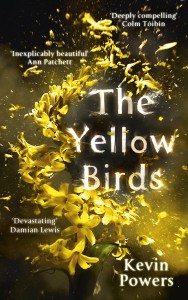
The Yellow Birds (2012) Kevin Powers


Back in 2006, I spent the last few months of my degree course writing about the presentation of Post Traumatic Stress Disorder in the novels of Vietnam War veteran Tim O'Brien. I had previously enjoyed the poems of Wilfred Owen and still enjoy teaching them to pupils at school. I clearly enjoy reading about the torture that young men who go to war sense upon returning home, unable to clearly describe the sights that they have seen and the horrors they have endured. So, all that having been said, I was looking forward to this novel.
The novel focuses on Bart and Murph, two young soldiers who have come from humble backgrounds to join the army and fight in Iraq. The chapters flicker back and forth on his time before joining the army; fighting in Tal Afar; and his return home. There is some extremely good writing in this debut novel right from the opening lines: "The war tried to kill us in spring. As the grass greened the plans of Nineveh and the weather warmed, we patrolled the low-slung hills beyond the cities and towns. We moved over them and through the tall grass on faith, kneading paths into the windswept growth like pioneers. While we slept, the war rubbed its thousand ribs against the ground in prayer." For a first novel there are often passages like this which are majestic, accomplished writing.
Powers' writing has been compared to many literary greats of the American canon: Hemingway, O'Brien, Melville, and his admirers are not of low calibre - Hilary Mantel, Colm Toibin and Ann Pratchett are all fans. However, Powers does occasionally slip into cliché, "I hated the way he excelled in death and brutality and domination. But more than that, I hated the way he was necessary, how I felt like a coward until he screamed into my ear 'Shoot these hajji fucks!' I hated the way I loved him when I inched up out of the terror and returned fire, seeing him shooting too, smiling the whole time." He might as well have brought Lieutenant Dan back from catching shrimps with Forrest and put him into Tal Afar. 
Powers says that the reason he wrote the novel was to try to explore the question: "What does it mean to try to be good and fail?" Something that struck me as I was reading this is that I am not sure that this question is explored fully: He made an unrealistic promise to a soldier's mum that he would look after him. He became desensitised to death whilst being a solider. He struggled to socialise and to find purpose in life upon his return. The novel is lauded as being a masterpiece, but I believe that it is 'only' good. Perhaps when more literature comes out of our very recent endeavours in Iraq and Afghanistan, the 'masterpiece' tag that Kevin Powers now holds will be reassessed.

Key quotations


  • "All pain is the same. Only the details are different."
  • "Freedom is not the same as lack of accountability."
  • “I knew that at least a few of the stars I saw were probably gone already, collapsed into nothing. I felt like I was looking at a lie. But I didn't mind. The world makes liars of us all.” 
Other thoughts
  • I really wanted to like this novel but found myself getting bogged down by it and feeling it didn't flow. Having just looked at my chosen quotations and had a good think about it, it's got some exceptional writing in it. Maybe I need to read it again in the future and see if my mind changes. We'll see.  


Tuesday, 9 June 2015

All Over Creation (2003) Ruth Ozeki


My parents gave me this book for Christmas having added it to my Amazon wish list after reading Ozeki's Booker Prize shortlisted 'A Tale for the Time Being.' I had also added her other book, 'My Year of Meats,' but that remains on the Amazon which I put down to my mother thinking that vegetarianism is akin to witchcraft and I might be converted. 

Yumi Fuller is a Japanese-American lady who was born into a family of potato farmers in Idaho. At the age of fourteen she has an affair with her history teacher, which leads to her having an abortion and leaving home. Twenty-five years later, she receives a call from her friend and next door neighbour Cass telling her that her parents can no longer cope with their age-related illnesses, so she returns to look after them. Throw some activists protesting against genetically-modified food and a hell of a lot of seeds into the mix and there's your story.

The novel is unquestionably an ambitious one. The multiple narrative; the array of characters of all different ages; the themes of life and death, family, friendship; the idea to write a novel about potato farming and make it interesting are all central to the success of 'All Over Creation.' Ozeki's personal life is also mirrored in the novel with the main protagonist's father being American and mother being Japanese and an Alzheimer's sufferer. I preferred this nod to the writer's personal life to her naming a character after herself in 'A Tale for the Time Being,' which I just found rather odd.

Through Yumi and Cass, the novel's two most central characters, Ozeki is most successful. Both characters are flawed but both evoke very strong emotions from the reader: the harrowing accounts of Yumi's trip to have an illegal abortion and Cass having yet another miscarriage - something that she is so used to that the description of it happening is reduced to a short paragraph, before she returns to bed without telling her husband of the pregnancy or the latest trauma, are painful to read. At other times I was left shaking my head at Yumi's absent approach to parenting or Cass's slight disappointment that her best friend wasn't dead.

Something that slightly bothers me about Ozeki's (and anybody who falls into this trap) writing is being rather contrived in the first place, and then explaining it to the author in the second. She has a big thing about character names: Yumi/yummy/You Me; a character in 'A Tale for the Time Being' called Nao... The novel had me groaning slightly with her rapist teacher and potato-botherer being called Elliot Rhodes and then one of the Seeds explaining that it is the same as erodes. I think most readers may have worked that out on their own.

The novel is about life and death. The author makes reference to the Buddhist belief that only two things are certain in life: You know that you will die and you don't know when it will be. Life, despite its difficulties, is celebrated in this novel and the continual reference to seeds are not accidental. Yumi's parents sell seeds from Asia in Idaho, Elliot Rhodes works as a PR officer for a GM seed company, the activists call themselves 'The Seeds of Resistance.' and so on. 

After struggling through 'H is for Hawk,' this was quite an easy read and an enjoyable one. Ozeki is by no means the perfect author, but she is an incredibly adept one of whom I'd happily read more from. Before starting this novel, I picked up Mark Haddon's 'A Spot of Bother' to read after 'The Curious Incident of the Dog in the Nighttime' came to Birmingham and left without me getting to see it. After a couple of pages, I gave up as I need to be in the right frame of mind for a novel. I'm glad I grabbed this one off the shelf.


Quotations

“As someone who has to teach for a living, I shouldn't be saying this, but the planet can do quite well without books.”  Hmmm.

"Secondly we believe anti-exoticisim to be explicitly racist, and having fought for Freedom and Democracy against Hitler, I do not intend to promote Third Reich eugenics in our family garden."

"It starts with the earth. How can it not?"

Other thoughts

  • At first I thought the way that Ozeki presented the hippie community was a bit...naff. I stand corrected though as they turned out to be excellent smaller roles in the novel leading to the catastrophic climax.
  • I don't think Yumi will be winning mother of the year.
  • Ozeki said that Yumi was named after 'You...Me.' I got that part, but she also said it's a tribute to one of the best songs of the seventies. Which song is that? Answers on a postcard please.
  • I got three books in the post yesterday: 'The Yellow Birds' by Kevin Powers, 'The Leopard' by Giuseppe Tomasi di Lampedusa and 'Axeman's Jazz' by Ray Celestin. What next? 


Thursday, 4 June 2015

'H is for Hawk' (2014) Helen Macdonald


Before I started writing this blog, my aim was simple: one book a week. Third book in and I have failed miserably. There are reasons for this, of course, but failing this early is not something I had on my list of  things I wanted to happen in May. It was a simple list of three:

1/. To watch my beloved Aston Villa win the FA Cup.


I suppose it could be argued that this was out of my control. I had queued outside Villa Park From 3.55am for tickets for the final and I knew it'd be worth it because it was Villa's year. The week building up to the final was consumed by excitement and feverish nerves about how it would be the first time since 1957 that we won the cup.

We didn't win the cup and I am still licking my wounds and wondering why bad things happen to good people. 

2/. Do something to the house. 


This is possibly more what Penny wanted to get done in May more than what I wanted to do. It was half term and I wanted to put all of my efforts into preparing for a trip to London. However, the conservatory in the new(ish) house was sadly lacking anything that could be described as a floor and we needed to get it done. 
We got it done - finishing at 12-something am, woke up and realised we had to do it all over again. Several coffees, a couple of arguments and lots of painful limbs later and it's done. Woohoo.

3/. Read the bloody book.

For some reason, this was a struggle. It wasn't that I didn't like the book - there's a lot of things that I loved about the book: I think that it's simply that my mind was in a few different places whilst reading it. I'd had a torrid time at work over the last few months which were probably enough to make a monk swear and I was exhausted. Half term, a gruelling cup final and a newly finished floor gave me fresh vigour though, and I finally finished it.

The book won the Costa Book of the Year and the Samuel Johnson Prize and it is very easy to see why. It intertwines Macdonald's very personal account of the struggle to come to terms with her father's death, a biographical account of T.H. White (writer of The Sword in the Stone and goshawker) and, of course, account of Macdonald's purchase and training of a goshawk called Mabel. 

I watched an interview with Macdonald where she talked about the personal nature of her account and she said that she had tried avoiding writing about the her grief in such detail when she first started writing it, but it simply did not work. She eloquently describes her feeling of desolation several times through the book, even down to the etymology of 'bereavement': “Here’s a word. Bereavement. Or, Bereaved. Bereft. It’s from the Old English bereafian, meaning ‘to deprive of, take away, seize, rob’. Robbed. Seized. It happens to everyone. But you feel it alone. Shocking loss isn’t to be shared, no matter how hard you try.” 

This isn't to say that H is for Hawk is a purely a cathartic experience. There are parts which make me laugh; there are parts that stir a fascination in the goshawk and there are others that conjure vivid images. I quite enjoyed imagining a lady walking round Cambridge with a hawk on her wrist swearing at joggers. 

Macdonald's account is not an easy read. It is dense and thorough with descriptions and requires a degree of patience. If that sounds like a negative review, it is not. It is ultimately a rewarding read exploring a woman's struggle and addiction. I can associate and empathise with her on the addiction front. She  reminisces about her childhood where she collects any literature she possibly can on goshawks and falcons and talks about the birds with her parents to the point of tedium. I did the same by banging on about football to my parents, friends, sisters. Macdonald writes:

"What I had just done (hunting with Mabel) was nothing like birdwatching. It was more like gambling, though the stakes were infintely bloodier. At its heart was a willed loss of control. You pour your heart, your skill, your very soul into a thing - into training a hawk, learning the form in racing or the numbers in cards - then relinquish control over it. This is the hook. Once the dice rolls, the horse runs, the hawk leaves the fist, you open yourself to luck and you cannot control the outcome. Yet everything you have done until that moment persuades you that you might be lucky... That little space of irresolution is a strange place to be. You feel safe because you are entirely at the world''s mercy. It is a rush. You lose yourself in it. And so you run towards those little shots of fate, where the world turns. That is the lure: that is why we lose ourselves, when powerless from hurt and grief, in drugs or gambling or drink; in addictions that collar the broken soul and shake it like a dog. I had found my addiction on that day out with Mabel. It was as ruinous, in a way, as if I'd taken a needle and shot myself with heroin. I had taken flight to a place from which I didn't want to ever return."

There is, one key difference between my addiction and Helen Macdonald's. Walking down those steps at Wembley at 7.45pm on Saturday, I felt as if I didn't ever want to return to watching Villa: I was drained. Maybe I should get myself a hawk. 

Other thoughts

  • There were a couple of passages about gender and sexuality and their relation to nature. Is hawking a 'man' sport? Are books written about nature primarily written by homosexual authors? What is clear is that animal companionship is often a cure for loneliness and a metaphorical bandage for a number of wounds.
  • Very few pages went without the leitmotif of birds. Robins, rooks, owls, sparrows, robins. You name it. The book practically flutters as you read it.
  • The cover of this book is a thing of beauty. Definitely one of my favourites.
  • I like Helen Macdonald: she favourited a Tweet of mine.

Saturday, 16 May 2015

The Cuckoo's Calling (2013) Robert Galbraith


When reviewing this book, Mark Lawson commented "Lucky, though, are those few who read it in the purity of obscurity rather than the distracting glare of hindsight." The distracting glare, of course, being that Robert Galbraith is JK Rowling's pseudonym. It shouldn't be an issue, of course. Who cares if the writer is JK Rowling, or an unknown writer who has written an accomplished debut? Who cares if it is a woman or a man?

Even though it does not matter, it does add an intriguing element to it. The novel is a thoroughly enjoyable detective novel, focusing on a slightly different hero to JK Rowling's more famous magical schoolboy. Private detective Cormoran Strike is a brooding, heavy, former soldier with a prosthetic leg, debt and a myriad of issues in his personal life. Meanwhile, a beautiful model has fallen from a Knightsbridge flat and foul play is suspected. Put two and two together and you get a detective novel.

I will focus on the positives first. As with all of JK Rowling's novels, it is very readable: the prose is engaging (if not at all challenging) and the plot moves seamlessly throughout. She seems to enjoy the conventions of the genre and does not attempt to move away from what is expected of a dying breed of novels. When I read a detective novel, I expect the detective to be solitary; I look forward to reading about a dysfunctional family and I anticipate more twists and turns than a proverbial bag of pretzels. This novel does not disappoint.  I actually enjoyed the novel far more than I thought I would, having thought 'The Casual Vacancy' was soulless and a bit of a chore to read.

It was also interesting to read Rowling's attacks on the press and politicians. With regards to the former, there are some similarities between the early assertions of what happened to Lula and the death of Princess Diana. This is an interesting aside, particularly when you consider that JK Rowling has been one of the more high profile figures involved in the Leveson Inquiry. It appears to be an itch worth scratching for Rowling, and she probably delights in being able attack 'News of the World' in the pages of this novel.

There are a couple of 'howevers' though. Firstly, I am not sure how I feel about JK Rowling's presentation of the working class. She did it in 'The Casual Vacancy' with Krystal Weedon (Weedon? Really? I'm sure you can do better than that Rowling. What next? Chardonnay Pissedup?) and she does it again in this novel: working class people speak in text-speak-like dialects: "Oh yeah, an' 'e was full of 'ow 'e was gonna 'elp an' shoulder 'is respons'bilities, an'make sure I wuz all right." Meanwhile the middle class and upwards speak using the Queen's English. It's a bit of a personal gripe this one. I think it's lazy and more to the point I think it's a tiny bit insulting.

On top of that - and this is where more uncertainty comes in having praised Rowling for her acceptance of following conventions before - she does love a stereotype Guy Somé is a fashion designer, for example, who holds out his hand "with a slight crook of the wrist," who has a "catlike" walk and a "camp and faintly cockney voice." Meanwhile I cannot help but think that Rowling's young, black men are not realistic in the slightest.

The book does have its faults (as they all do), but these are things that I believe that the author will never change. Strike is an excellent protagonist in a compelling novel. It will be interesting to see how the series develops. 

Key quotes  

"The country was lumbering towards election day. Strike turned in early on Sunday and watched the day's gaffes, counterclaims and promises being tabulated on his portable TV. There was an air of joylessness in every news report he watched. The national debt was so huge that it was difficult to comprehend. Cuts were coming, whoever won; deep, painful cuts; and sometimes, with their weasel words the party leaders reminded Strike of the surgeons who had told him cautiously that he might experience a degree of discomfort; they who would never personally  feel the pain that was about to be inflicted."

"The motherfuckin' press chased her out that window."

Other thoughts

Without wanting to sound like a teenage groupie, I read the whole novel believing that Strike was similar to Al Swearengen and Evan Duffield was Russell Brand.

I enjoyed Strike being surprised that his temporary receptionist had good intuition AND punctuation.

Strike definitely needed a jolly good shag from Ciara. Good for him.

Despite my criticisms, I definitely want to read more Cormoran Strike novels.

Thursday, 14 May 2015

Any recommendations?

I try to read as many different novels as possible. I try not to read any rubbish and I also cannot get on well with fantasy or sci-fi. I recently started reading 'Station Eleven' after hearing from every man and his dog that it was 'wonderful.' I got half way through it and thought it was wonderful that I managed to sell it on Amazon and got my money back. I'm now reading 'The Cuckoo's Calling' by Robert Galbraith which I thought would be rubbish but has been a pleasant surprise - more on that later. Any recommendations for what I should read in the future?

'Cry, The Beloved Country' (1948) Alan Paton


I wanted to read this on our honeymoon as it's about South Africa, and we were in, well, South Africa. Instead I read the excellent laugh-a-minute romp, Booker-Prize winning 'The Narrow Road to the Deep North' which seemed befitting of such a joyous occasion.

Back on more familiar shores I set to reading this. It was written in 1948 in Apartheid-ruled South Africa by Alan Paton who the National Party in South Africa found to be a nuisance for years to come. The novel focuses on a black priest, Stephen Kumalo who goes on a journey to Johannesburg in search of various family members who have left their tribe for a better future in the nation's biggest city. He finds out that his sister has only survived through means of prostitution and his son is nowhere to be found, but rumours are that he is with a bad crowd and up to no good.

The novel is astonishingly good. Considering that it was written in a country where equality was only being whispered about 40 years later, it includes quotations that are powerfully relevant to today's South African society: "I see only one hope for our country, and that is when white men and black men, desiring neither power nor money, but desiring only the good of their country, come together to work for it."  and “I have one great fear in my heart, that one day when they are turned to loving, they will find that we are turned to hating.” Without turning into a history bore, it struck me that the quotations are not too dissimilar from Nelson Mandela saying that the only way for South Africa to progress is by forgiveness. This novel questions how easy it will be for the black community in South Africa to forgive the imperial powers that took away their country as they knew it:“The tragedy is not that things are broken. The tragedy is that things are not mended again.” 

The novel somehow manages to evoke images of the country and the difference between the peaceful, yet struggling countryside and the corrupt labyrinth of the big city. Even though the land is dry; the cows are eating away at what little grass there is (the tribesmen bought wives with cows, why would they want to decrease the number they have?); there is no milk and the babies are dying, somehow the move to Johannesburg does not really improve the life of the migrants who have moved for a better lifestyle. The novel has one or two chapters which take us away from the main characters and look at how townships started growing in South Africa and these were some of the most enlightening chapters for someone who doesn't know the history of such things, exploring the exploitation involved in the birth of these places. They are still going strong - Penny and I drove past so many of these landscapes on our drives in South Africa and as such it was fascinating to read about them:


I wish I had read the novel whilst I was away. It was utterly heartbreaking in some respects and offered hope in others. Paton is a staunch Christian man and the novel focused on a religious man and had a parable-like tone to it, but that added to it. It is a novel that must be read.

Key quotations
“But there is only one thing that has power completely, and this is love. Because when a man loves, he seeks no power, and therefore he has power.” 

“Pain and suffering, they are a secret. Kindness and love, they are a secret. But I have learned that kindness and love can pay for pain and suffering. ” 

“Happy the eyes that can close” 

“There is not much talking now. A silence falls upon them all. This is no time to talk of hedges and fields, or the beauties of any country. Sadness and fear and hate, how they well up in the heart and mind, whenever one opens pages of these messengers of doom. Cry for the broken tribe, for the law and the custom that is gone. Aye, and cry aloud for the man who is dead, for the woman and children bereaved. Cry, the beloved country, these things are not yet at an end. The sun pours down on the earth, on the lovely land that man cannot enjoy. He knows only the fear of his heart.” 

Quick final thoughts

  • What a lovely man Jarvis is. And what a shame that under different circumstances him and Kumalo could have been friends.
  • I am not sure what to make of Absolum or what to make of his mother's 'let's get on with it' attitude after the sentence was upheld.
  • Poor old Kumalo making his journey up that mountain. 


Monday, 11 May 2015

Starting the blog

I've started this blog to write about the books I read for a couple of reasons. Firstly, so I can remember what on earth I have read. This is a perennial problem for me - I can usually remember all the details about a book, without remembering the author or the title. Secondly, so I can discuss the merits of the novel and its characters, plots and themes as I read them and after I have completed them.
Hopefully it's a success!